
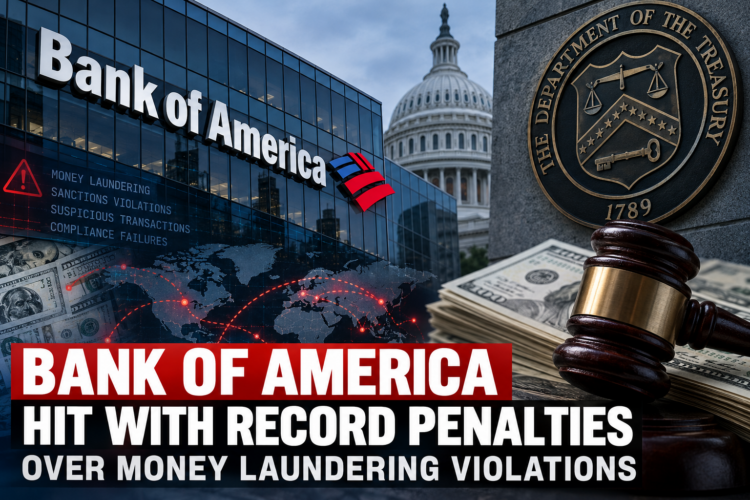
WASHINGTON—The U.S. Treasury Department announced enforcement actions against Bank of America for violations of federal anti-money laundering and sanctions laws, including failures to report more than $5 billion in suspicious financial transactions.
The actions involve three federal regulators and include the third-largest penalty in Treasury history and the largest penalty ever assessed by the Office of the Comptroller of the Currency.
The Financial Crimes Enforcement Network, known as FinCEN, assessed a $1.2 billion penalty for failures involving suspicious transaction reporting and anti-money laundering controls. The OCC separately assessed a $750 million civil penalty, while the Office of Foreign Assets Control reached an $11.6 million settlement involving apparent sanctions violations.
The individual penalties and settlements total approximately $1.96 billion, although Treasury described the combined enforcement actions as exceeding $1.21 billion.
“Financial institutions are on the front lines of protecting our economic and national security,” Treasury Secretary Scott Bessent said. “When a bank of this size fails to meet its anti-money laundering and sanctions obligations, the consequences extend far beyond its own walls.”
As part of its resolution with FinCEN, Bank of America admitted to willfully violating the Bank Secrecy Act by failing to maintain an adequate anti-money laundering program, conduct required due diligence on certain foreign banking relationships and file suspicious activity reports.
Treasury said the bank failed to report more than $5 billion in suspicious transactions in a timely manner. More than $1 billion involved potential national security risks, including transactions associated with Chinese money laundering networks, suspected fraud and possible trade-based money laundering connected to the southwestern U.S. border.
Regulators found that Bank of America relied heavily on law enforcement inquiries and referrals from other financial institutions rather than its own monitoring systems to identify suspicious activity.
The OCC said the bank’s transaction monitoring deficiencies affected trillions of dollars in transactions and resulted in large numbers of delayed suspicious activity reports.
The agency also found that Bank of America failed to address longstanding compliance problems despite a December 2024 cease-and-desist order requiring improvements.
According to regulators, the bank’s anti-money laundering personnel lacked sufficient training and expertise, while internal audits failed to identify significant compliance deficiencies.
Separately, Bank of America agreed to settle potential civil liability for 475 apparent sanctions violations involving programs targeting Russia, Belarus, Iran, Burma, Somalia, narcotics trafficking and global terrorism.
Treasury said the violations resulted from technical failures, improperly configured sanctions screening systems, delays in updating watchlists and human errors that allowed certain prohibited transactions to be processed.
OFAC classified the apparent sanctions violations as non-egregious and said most were not voluntarily disclosed by the bank.
Under the FinCEN consent order, Bank of America must conduct a retrospective review of transactions that may have gone undetected and report additional suspicious activity when warranted. The bank must also undergo independent reviews of its transaction monitoring, customer due diligence and foreign correspondent banking controls.
The reviews will focus partly on financial risks involving drug cartels, narcotics trafficking, Iran and Russia.
Treasury said the enforcement actions highlight the responsibility of major financial institutions to maintain effective systems for detecting money laundering, sanctions violations and other potentially illicit financial activity.