
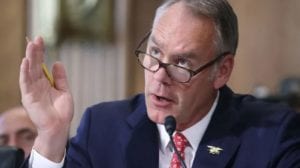
WASHINGTON — Retiring Western Montana Congressman Ryan Zinke secured more than $22 million in community project funding and a broad range of Montana agriculture and policy priorities across three fiscal year 2027 appropriations bills that advanced through the House last week.
The FY27 Agriculture, Rural Development, Food and Drug Administration Appropriations Act passed the full House, while the FY27 Interior, Environment, and Related Agencies Appropriations Act and the FY27 Transportation, Housing and Urban Development Appropriations Act passed full committee markup and headed to the House floor for a vote. Zinke, a member of the House Appropriations Committee, helped craft all three bills.
The agriculture bill included $4.8 million in community project funding for rural infrastructure improvements across western Montana, targeting wastewater and water systems in Columbia Falls, Libby, and Ronan, emergency communications upgrades for the Confederated Salish and Kootenai Tribes and Lake County, and equipment funding for the Charlo Volunteer Fire Department.
On the agriculture policy front, the bill provided $1.16 billion for the Animal and Plant Health Inspection Service to protect American agriculture from foreign pests and diseases including High-Path Avian Influenza and New World Screwworm. It also strengthened oversight of foreign ownership of U.S. agricultural land by adding the Secretary of Agriculture to the Committee on Foreign Investment in the United States for reviews involving foreign adversaries including China, Russia, North Korea, and Iran.
Montana-specific agricultural research priorities in the bill included an additional $500,000 for pulse crop health research — benefiting Montana as one of the nation’s leading producers of dry peas, lentils, and chickpeas — increased funding for the Barley Pest Initiative supporting Montana’s top barley production sector, and maintained funding for precision livestock management and semi-arid soil health research critical to western rangelands.
The Interior and THUD bills included $17.5 million in additional community project funding, highlighted by $5 million for the Noxon Bridge Replacement Phase II in Sanders County and $2 million for critical minerals extraction research at Montana Tech in Butte. Other projects funded included wastewater system upgrades in Lakeside, Bigfork, Charlo, Lolo, Seeley Lake, and Ravalli County, flood resiliency improvements in Evergreen, clean water infrastructure in Granite County, and road repairs in Corvallis.
Beyond direct project funding, Zinke secured several significant policy provisions in the Interior bill. The legislation directed the Interior Department to delist recovered grizzly bear populations in the Northern Continental Divide and Greater Yellowstone ecosystems within 180 days, returning greater management authority to state wildlife agencies. It also provided a permanent legislative fix to the Cottonwood court decision, limiting when the Forest Service must reinitiate consultation with the Fish and Wildlife Service in a move intended to reduce delays in logging and forest management projects. A prohibition on federal funding for bison introduction into the Charles M. Russell Wildlife Refuge preserved existing grazing agreements relied upon by eastern Montana ranchers.
The THUD bill directed the Federal Highway Administration to ensure rural highway projects in counties under 50,000 residents receive fair consideration for infrastructure funding, and created a pilot program allowing on-time rent payments to be reported to credit agencies to help renters build credit history and improve pathways to homeownership.
All three bills now advance to the Senate, where further negotiations are expected before any final spending agreements are reached.