
Three-quarters of Americans and nearly seven in 10 Canadians have sought financial guidance from at least one source in the past year, according to a new study from Gallup conducted in partnership with Edward Jones, though the sources people rely on most are not always the ones they trust most.
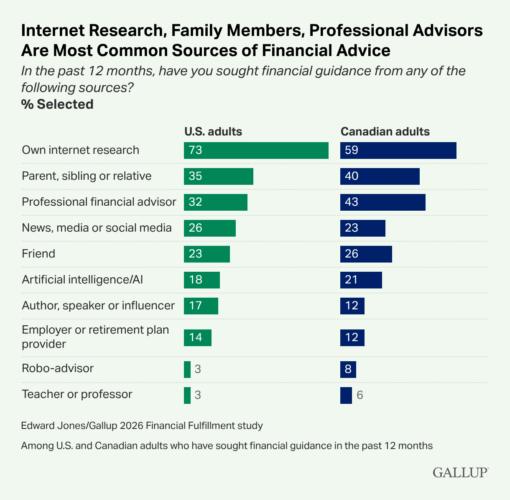
Among U.S. adults who sought guidance, 73% used their own internet research, more than any other source. Family members ranked next at 35%, followed by professional financial advisers at 32%, news and media or social media at 26%, and friends at 23%. Eighteen percent turned to artificial intelligence tools, including ChatGPT, Claude and similar assistants.
Canadians relied on many of the same sources but at different rates. Internet research also led in Canada, at 59%, while Canadians were more likely than Americans to turn to professional advisers, at 43%, and family members, at 40%.
Guidance-seeking varied by generation in both countries, with younger adults more likely than older ones to have sought advice at all. In the U.S., the share ranged from 81% among Generation Z adults to 70% among baby boomers; in Canada, the spread was wider, from 83% among Gen Z adults to 58% among boomers.
The generational divide was sharper in which sources people used. About one in four Gen Z adults and millennials in the U.S. used AI for financial guidance, compared with 7% of baby boomers; Canada showed a similar pattern, with AI use around 30% among Gen Z adults and millennials and considerably lower among older adults. Reliance on professional advisers moved in the opposite direction, rising from 14% among Gen Z guidance-seekers in the U.S. to 55% among baby boomers, and from lower levels among young Canadians to 65% among Canadian boomers.
The study also measured how much confidence adults place in each source’s expertise, and found notable gaps between usage and trust. Financial advisers received the highest confidence ratings in both countries: 79% of Americans and 76% of Canadians expressed at least some confidence in advisers’ expertise, including roughly a quarter in each country with “a great deal” of confidence. Majorities in both countries also expressed at least some confidence in finance professors, family members, and friends or colleagues.
AI ranked far lower. No more than three in 10 adults in either country expressed even some confidence in AI as a source of financial guidance, and very few expressed a great deal of confidence — 3% in the U.S. and 4% in Canada. Confidence in social media influencers was lower still. Even among the age groups most likely to use AI, trust remained limited: 36% of U.S. millennials and 32% of Gen Z adults expressed at least some confidence in AI tools, compared with 27% of Gen Xers and 15% of baby boomers.
The study also examined how guidance-seeking relates to what Gallup and Edward Jones term “financial fulfillment” — a measure of whether a person’s finances support the life they want, rather than simply their income or wealth. Researchers categorized adults as financially fulfilled, financially conflicted or financially stressed based on that standard.
Adults across all three categories sought guidance at similar rates, but the sources they used differed. In the U.S., financially stressed adults were more likely to turn to people close to them, with 43% seeking advice from family and 28% from friends, compared with 19% and 13%, respectively, among the financially fulfilled. AI use also tilted toward the financially stressed, at 21%, versus 15% among the fulfilled. A similar pattern held in Canada, where financially stressed adults leaned heavily on family and friends and used AI at higher rates than the financially fulfilled.
Financially fulfilled adults, by contrast, were more likely to draw on professional advice. In the U.S., 60% of financially fulfilled guidance-seekers had worked with a professional adviser, compared with 33% of the financially conflicted and 14% of the financially stressed. The gap was even wider in Canada, where adviser use rose from 26% among financially stressed adults to 74% among the financially fulfilled.
The study’s authors cautioned that the pattern does not mean financial fulfillment is simply a byproduct of hiring an adviser, nor that greater wealth automatically produces fulfillment; income and net worth did not fully explain differences in fulfillment among respondents. Instead, the findings suggest that financially fulfilled adults tend to combine several sources over time — their own research, personal networks and professional expertise — more often than adults in the other two categories.