
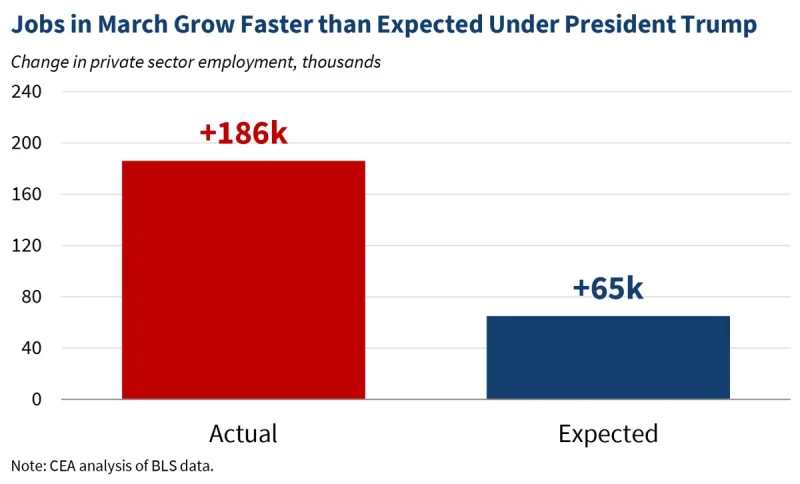
The White House on Friday celebrated a stronger-than-expected March jobs report, saying the numbers validated President Trump’s economic agenda and signaled accelerating momentum heading into the second quarter of 2026.
The economy added 178,000 jobs in March, nearly triple what economists had forecast, according to the Labor Department. The unemployment rate dipped to 4.3% while private sector weekly earnings rose 3.9% over the past year.
White House spokesman Kush Desai credited the results to what he described as Trump’s proven agenda of tax cuts, deregulation, tariffs and energy dominance, and said the numbers reflected the early materialization of trillions of dollars in new investments. Desai also referenced what the administration has called “Operation Epic Fury,” suggesting short-term economic disruptions tied to that effort would give way to further acceleration.
Manufacturing was among the standout sectors, adding 15,000 jobs in March. The White House said that capped the first quarter of 2026 with the first positive manufacturing job growth in three years, framing it as a reversal of what it characterized as Biden-era decline. Construction added 26,000 jobs, driven by gains in specialty trades and residential building.
The administration also highlighted labor force participation trends, noting that women aged 25 to 54 reached a record-high participation rate in March, while prime-age male participation remained near its highest level since 2009.
Overall, the economy has added an average of 68,000 jobs per month in 2026, which the White House said represents a clear improvement over 2025 and a significant outperformance of economists’ projections.
The administration also pointed to reductions in the federal workforce as a feature rather than a drawback, saying the federal payroll has shrunk to its smallest level since 1966 and its lowest share of the total labor force in more than a century, arguing the shift reflects a deliberate effort to redirect economic activity toward the private sector.