
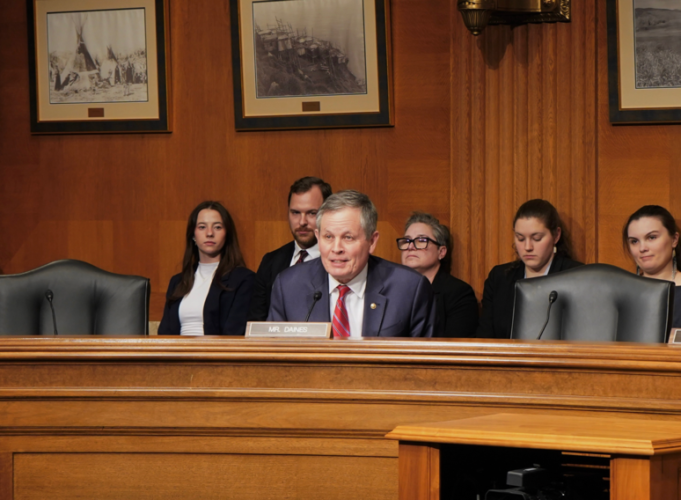
Sen. Steve Daines spoke at a Senate Energy and Natural Resources Committee hearing Wednesday, discussing legislation aimed at bringing clean drinking water to eastern Montana and reforming the federal hydropower licensing process.
On the Dry Redwater Regional Water Authorization Act
Daines outlined his bill authorizing construction of critical water systems in eastern Montana. He noted that Congress passed his earlier legislation in 2020 directing the Bureau of Reclamation to complete a feasibility study on bringing clean drinking water to Dawson, Garfield, McCone, Prairie and Richland counties in Montana, as well as McKenzie County, N.D. After a five-year study, Reclamation completed its findings, prompting the Montana congressional delegation to draft and introduce Senate Bill 4489, which would federally authorize the water system and add it to the federal rural water program.
“I want to show my colleagues why this bill is so important and why I have been working on rural water issues in this committee since day one,” Daines said, presenting the committee with water samples from McCone County, Mont. “I’m not bringing these samples from a third-world country. This is literally water coming out of some faucets in McCone County in Montana. … You never want to think about pouring that out of your faucet and taking a sip of water from it. Obviously, this is water that families in Montana should not be drinking.”
Daines said the bill would authorize the Dry Redwater Regional Water Authority system, bringing clean drinking water to more than 30,000 Montanans in towns including Glendive, Circle, Richey, Jordan and Sidney. “I look forward to working with the Bureau of Reclamation and this community to get this bill to the President’s desk and be in construction of this important project,” he said.
On the Hydropower Licensing and Affordability Act
Daines also discussed Senate Bill 5048, the Hydropower Licensing and Affordability Act, which would make targeted changes to Sections 4(e) and 18 of the Federal Power Act to ensure federal agencies focus on the direct effects of a project when licensing or relicensing hydropower dams.
Daines said federal agencies have “weaponized” a process known as mandatory conditioning, which allows agencies to require hydropower operators to complete specific actions before receiving a license. He said the practice has repeatedly affected projects in Montana and across the West, driving up costs and threatening the continuation of existing hydropower facilities. As an example, he cited the ongoing relicensing of the Thompson Falls Dam in Montana, where he said the delegation is pushing back against what it considers unnecessary and unrelated conditions from federal agencies.
Daines said the bill would address the issue without weakening environmental or endangered species protections or limiting tribal and state consultation, by adding a single line to existing law specifying that mandatory conditions must be limited to those that “reasonably mitigate the direct adverse effect of the applicable project.”
“This is straightforward and should not be a controversial proposal,” Daines said. “I look forward to working with the Chairman to include this in the permitting package or a future markup.”
By: BSB News wire