
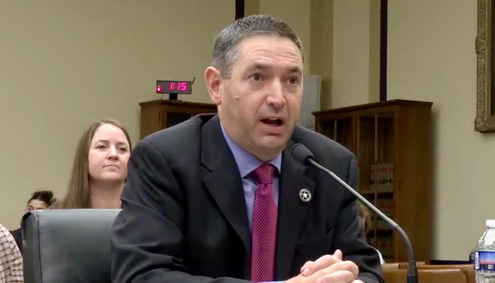
Montana Attorney General Austin Knudsen testified Tuesday before the U.S. House Judiciary Subcommittee on Crime and Federal Government Surveillance on the missing and murdered Indigenous persons crisis, outlining jurisdictional challenges that hamper coordination among tribal, federal and local law enforcement in addressing the issue.
During the hearing, titled “Missing and Murdered Indigenous People: Strengthening Public Safety in Tribal Communities,” Knudsen told lawmakers that state authority alone cannot resolve the crisis. “As Attorney General, my hands are tied. I have no jurisdiction on tribal land. The Montana Legislature can pass all the bills they want, but without action from Congress, we will never see meaningful change,” Knudsen said.
Knudsen, a former county prosecutor in Indian Country, told the subcommittee that missing Indigenous persons accounted for 31 percent of Montana’s reported missing persons cases last year, despite Indigenous residents making up roughly 6 percent of the state’s population. He noted that Montana is home to eight federally recognized tribes, which he said creates significant jurisdictional complexity for the state as it works to address the crisis.
Knudsen also challenged a common assumption about who goes missing. In 2025, 48 percent of all people reported missing in Montana were male and 52 percent were female; among Indigenous persons specifically, 40 percent of those who went missing last year were male. “Our current messaging that it’s only a problem for women leaves a large population of men and boys effectively ignored and left out of the conversation,” Knudsen said in written testimony submitted to the committee.
Knudsen noted that Montana’s overall clearance rate for missing persons cases was 99 percent last year, with only five people reported missing that year remaining unaccounted for. Still, he said 41 Indigenous persons remain missing in Montana today, 27 of whom have been missing for more than a year.
He pointed to several state-level efforts to address the crisis, including a real-time missing persons database maintained by the Montana Department of Justice that highlights Indigenous persons cases, a recently launched public service announcement campaign, and the Montana Missing and Murdered Indigenous Persons Advisory Council, which his agency administers. The state Legislature recently authorized the council to accept donations to fund its projects, and the council launched a specialty license plate earlier this year to help generate funding. The council also recommended a resolution, passed by the 2025 Montana Legislature, urging Congress to fully fund public safety and law enforcement efforts in Indian Country.
Knudsen told lawmakers that jurisdictional limits significantly constrain his agency’s ability to act. “My agents and law enforcement officers can’t do anything on tribal lands unless they are asked by a federal agency. That results in wasted time and wasted resources in some cases,” he said, citing as an example that Montana Department of Justice agents must accompany U.S. Marshals to conduct sex and violent offender registry compliance checks on tribal land, rather than performing the checks independently.
Knudsen noted some recent progress, including the cross-deputization of a Montana Division of Criminal Investigation agent, who will now have federal authority to assist with investigations into murders and missing persons cases on reservations across the state on a case-by-case basis. He also credited the Trump administration with opening an FBI field office in Billings, which he said signals greater federal commitment to addressing violent crime and cases occurring on tribal lands.
While reservations are sovereign nations exempt from Montana’s standard reporting requirements, Knudsen said the state has established agreements with seven of its eight reservations to improve missing persons reporting and help locate individuals more quickly.
“The missing and murdered Indigenous persons crisis has been plaguing our tribal communities for generations,” Knudsen told the subcommittee. “I’m thankful to the Trump Administration for taking the issue seriously, and to this committee for bringing this discussion to the table today as you continue to explore ways Congress can help solve the problem.”
By: BSB News wire